Art Reproduction
We provide a very high quality and colour-accurate art reproduction service.
We work with you to create high quality reproductions from your work, and help make your work more accessible to more people.
We provide friendly, knowledgeable, and comprehensive guidance on all stages of the process and on all issues related to fine art reproduction - from the initial high quality digital capture, through editing and library management, to the final printed output. There are never any time limits or costs for our help and advice; we'll be happy to cover any issues you like so you feel completely comfortable with the process and the world class results you will get.
More than 20 years of real world experience, collaborating with many of Australia's most successful artists, means quite simply nobody does this stuff better. If you're new to the process, or you've already had work done elsewhere but have never been completely happy - give us a try.
How It Works
1. One On One Consultation
This is where it all starts.
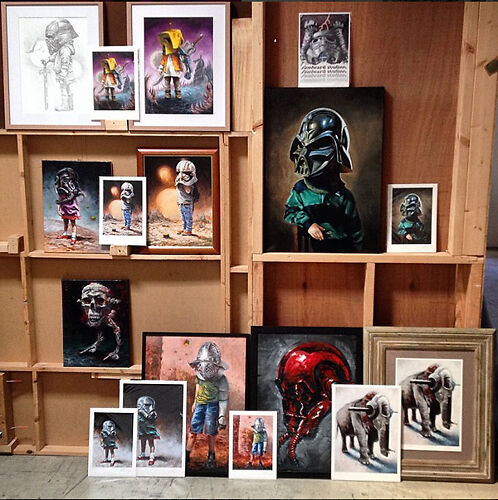
Please Contact Us to book a time for a free consultation to visit us with your artwork and for a chat to discuss your specific requirements before making your order.
2. Digital Capture
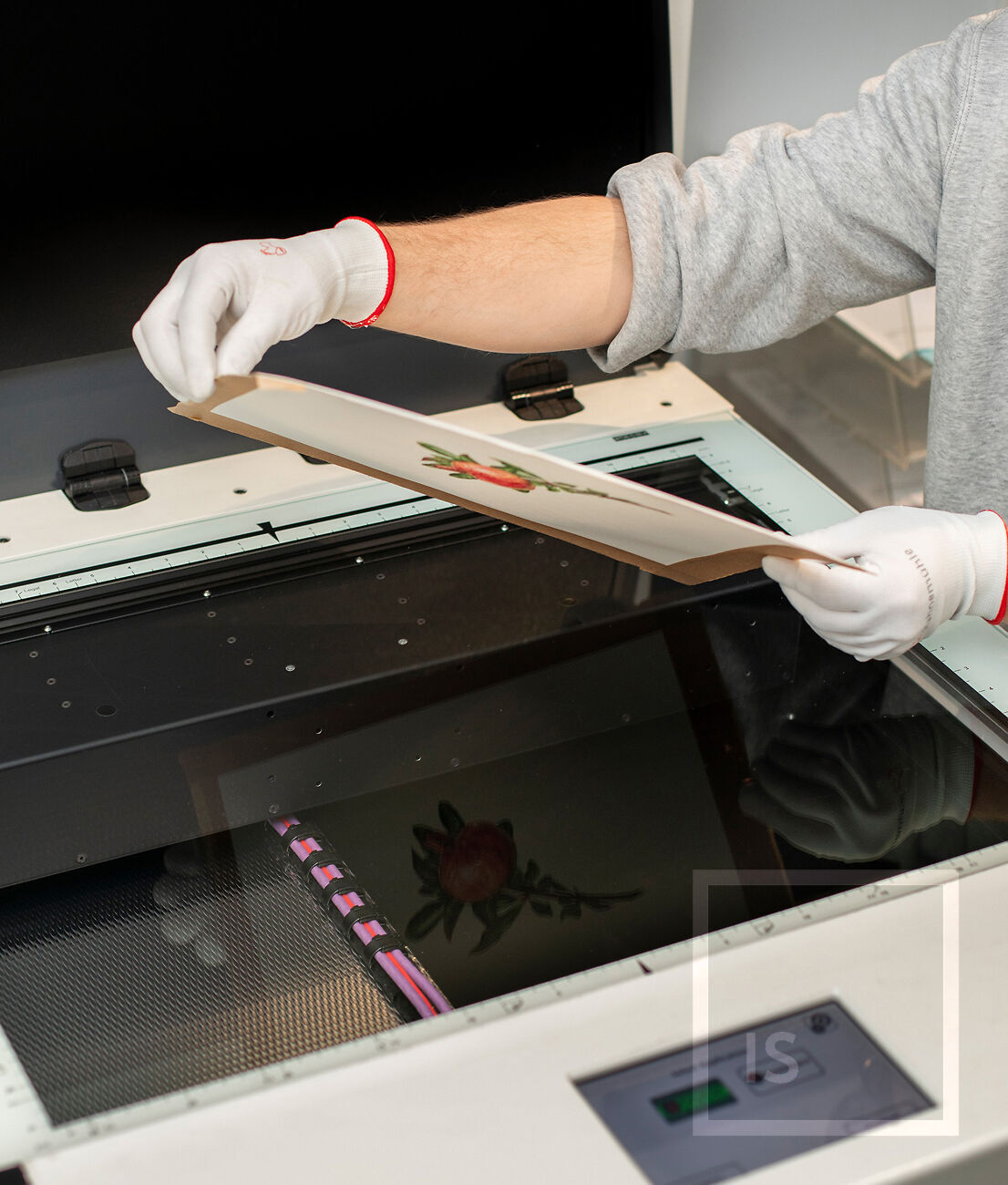
Leave it with us to create a high quality digital file. Most work is directly scanned on our state of the art artwork scanner.
We offer both Raw and Ready To Print scanning services - see the difference between these below.
Our pricing is dictated by original size, service and resolution.
Please note that we do require works to be removed from frames and mounts prior to bringing them in to us.
3. Retouching
If you've chosen our Ready To Print service we will undertake the necessary retouching to get your file accurate to the original and print ready.
Note that the retouching that is incorporated into the price for the Print Ready service is time budgeted. Some pieces with particularly complex colour concerns may take extra retouching.
4. Proof Prints
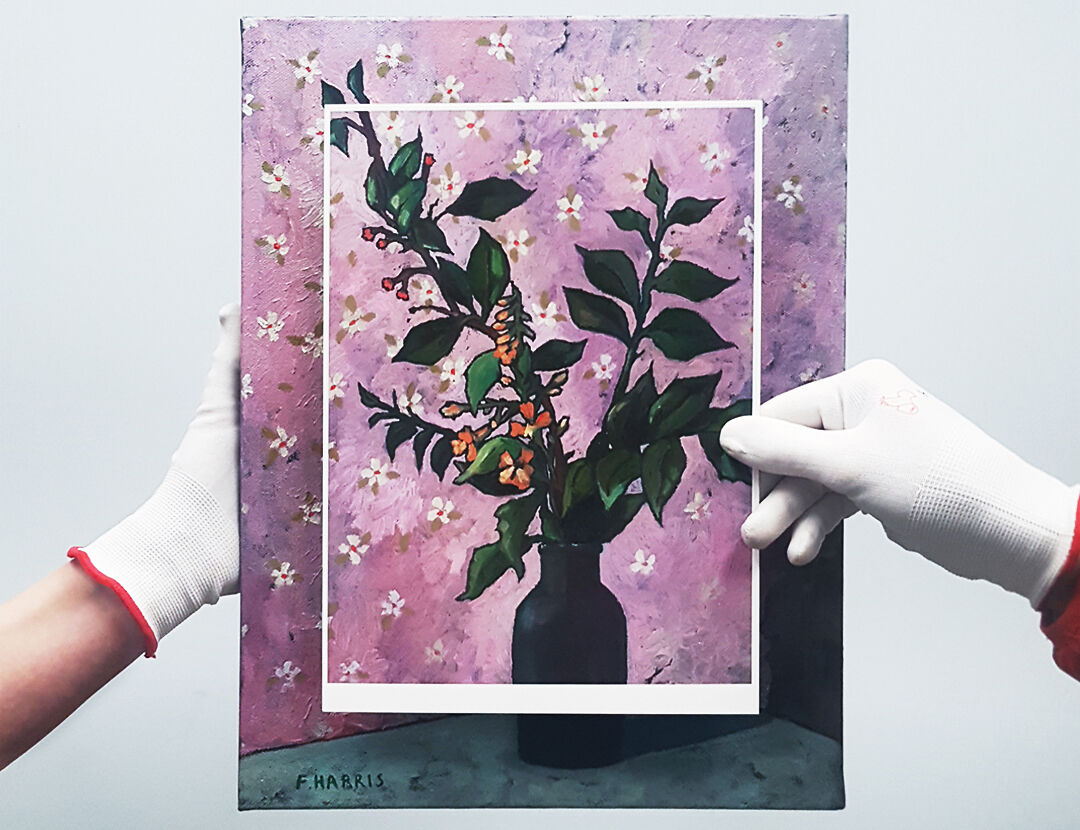
If you've chosen our Ready To Print service, we'll finish that process by producing A4 proofs of your work - showing you exactly where we've got to at the end of our standard retouching process.
95% of files are ready to go at this point, but occasionally more work is required (for a small fee) - and we carefully consult with you to get things exactly how you want them!
5. Ready For Edition Printing
After proofs are approved (or you've finished your own retouching work if you chose Raw Scans) - you're ready to Print your Art Reproduction edition - either all at once, or one by one as they sell, or in small quantities as needed. It's entirely up to you!
Art Reproduction - Our Advantage
At Image Science we use a state of the art scanner that has been specifically designed for artwork scanning (rather than consumer level scanners from e.g. Microtek or Epson that other services tend to use) that is custom colour profiled and produces incredibly detailed and exceedingly sharp scans of artworks.
Above and beyond simply having this fabulous machine, we have developed precise techniques with it - unique to Image Science - to get the absolute best quality, most accurate reproduction from this machine.
All our machines and every step of our workflow from capture, through editing, to proofing and printing is carefully calibrated, linearised and custom colour profiled to the highest and most stringent levels to ensure accurate, standardised, and consistent results that mean your prints are as close to your original as is possible every time.
Our machine and techniques produce results that retrieve ALL the detail of the original work. Both our 600ppi and 1200ppi resolutions are true optical resolutions - we do not interpolate in any way - so our scanner at 600ppi is much sharper and resolves dramatically more detail than other scanners which actually have lower interpolated resolutions (e.g. Epson flatbeds claiming 4800ppi).
With a bed 19% larger than a standard A2, our scanner scans up to 18 by 25 inches (approx 45 by 64 cm) in a single pass.
By seamlessly stitching multiple scans together we can scan larger pieces, to A1 and beyond!
We offer up to a maximum size of 90x180cm or 120x135cm (depending on aspect ratio).
Our scanner is also able to scan with both flat and relief lighting - meaning we can, if you wish, reproduce the dimensionality of your works (brush strokes, 3D embellishments etc.). Consumer scanners simply cannot do this.
Do note that 3D lighting is not available for oversize pieces (above A1).
We've got over over 20 years of high end art reproduction skills under our belts, and have worked for many of Australia's most exacting artists.
Even if you think you've had quite good scans in the past, you will find our service is capable of producing results that are quite simply a closer match to your original work.
It all starts with a chat - so get in touch today and rest assured we'll help you get properly set up with your art reproduction.
How We Charge
We charge based on three main factors:
Service Selection - Raw or Print Ready
We offer two types of scans: Raw Scans (unretouched), and Print Ready Scans (fully retouched).
Print Ready Scans have our retouching time built into the price. This is time budgeted, but typically includes dust/scratch/blemish cleanup type work, full colour correction, tonal balancing, correct assigning of black and white points, sharpening, and optional background tone stripping. This service also includes an A4 proof print in the price. Almost everyone chooses our Ready To Print service, as doing the necessary retouching work takes both great quality, calibrated, colour accurate equipment, and a lot of skill and experience to do well.
Raw Scans are straight out of the scanner with absolutely nothing done to them. They are 'warts and all' and will require retouching work done to them before they are accurate to the original and ready for print. Although our scanner is custom profiled and often quite colour accurate, the straight out of scanner 'raw' files are not yet completely print ready files - these files do still need some basic dust and scratch retouching, minor colour balancing work, and setting of final black and white points/contrast.
See our article on The Difference Between our Raw and Print Ready Services.
The Size of Your Original Artwork
We primarily charge based on size of your original piece, according to standard A-paper sizes - A5, A4, A3, A2, A1.
Our smallest size bracket is A5, and we have standardised pricing up to A1 in size.
Pieces smaller than A5 (e.g 4x6" photos, polaroids, small headshot proofs etc) are charged as A5, as there is a minimum amount of setup work required for each piece.
Larger than A1 in size requires a custom quote, which means we have to see the piece before we can give you an accurate quote. Please Contact Us.
We offer up to a maximum size of 90x180cm, or 120x135cm, depending on the aspect ratio of your piece.
Please note that as we scan, we do require works to be removed from frames and mounts prior to bringing them in to us.
The Scan Resolution
For A1 and under, we can scan at either 600ppi or 1200ppi depending on your needs. For oversize pieces (over A1) we only offer the 600ppi resolution.
In general, unless your originals are very small, or you are wanting to reproduce the work very much larger than the original size, the 600ppi scan is most appropriate for the majority of people.
These figures can initially be confusing to people used to using consumer scanners that claim to be able to scan at these same resolutions or even much higher figures. But our machine and techniques produce results that retrieve ALL the detail of the original work. Both our 600ppi and 1200ppi resolutions are true optical resolutions - we do not interpolate in any way - so our scanner at 600ppi is much sharper and resolves dramatically more detail than other scanners which actually have lower interpolated resolutions (e.g. Epson flatbeds claiming 4800ppi). See our FAQ below for more info.
Please note 1200ppi files can be massive and you will need a powerful machine to work with these - e.g. an A2 original scanned at 1200ppi results in literally gigabytes of data!
FAQs
We offer up to a maximum size of 90x180cm or 120x135cm (depending on aspect ratio).
Above A1 size requires a custom quote and necessitates seeing the artwork first, so please contact us to arrange an appointment.
Yes, we do require you to remove frames and mounts prior to bringing us your artwork.
We are unable to do this for you for liability reasons.
Listed below are the equivalent megapixel resolutions of our scanner at each size and resolution setting, and approximate file sizes.
Note: These figures are a raw pixel count only and do not account for the actual level of detail resolved, which is typically higher than a camera of the same raw resolution.
A4 600ppi - 40 MP - Approx 200mb
A3 600ppi - 80 MP - Approx 400mb
A2 600ppi - 165 MP - Approx 800mb
A1 600ppi - 300 MP - Approx 1.5gb
A0 600ppi - 600 MP - Approx 2.5gb
A4 1200ppi - 160 MP - Approx 800mb
A3 1200ppi - 320 MP - Approx 1.5gb
A2 1200ppi - 660 MP - Approx 3gb
A1 1200ppi - 1250 MP - Approx 6.2gb
Selling reproduction prints will definitely not decrease the value of your original
works.
(The effect is in fact precisely the exact opposite - the more a work is produced & recognised,
the greater the value of the 'one true original' - art sales have proved this time and again, over centuries).
When someone buys an artwork from you, they are buying only the physical
object to own and enjoy - but copyright to the actual image/object
remains with the original artist.
You have the right to use the image
for marketing purposes, and also for reproduction print sales purposes - indeed, you can use the image for anything you like!
(Note this is NOT true for commissioned works, where the copyright belongs to the commissioner of the work, unless you explicitly retained these rights in your contract of work - which you should!)
The short answer is: You can, but you will almost certainly be compromising the quality of your results by doing this work yourself.
The odds of the average person being able to do this up to a sufficient level of quality - one that reflects that work you put in to your original works, is very low. Even if you have a 'good camera' and some photographic skill. It's fair to say that even most general professional photographers (even those that are otherwise perfectly technically competent) are not up to the challenge of really high quality art reproduction work.
Art Reproduction photography is very hard. Sure, some artworks are easier than others, but as a rule art reproduction is probably the single most technically demanding field of photography there is, requiring a large array of technical skills and a deep knowledge of photography, colour and printing, to do really properly.
See our article here for the full breakdown of why it's best to have your work professionally reproduced.
The most important thing is to have the reproduction professionally done - art reproduction done via scanning OR photography is very difficult to do properly without both the appropriate equipment AND just as importantly experience and technique. There are many business out there these days offering these services - but the vast bulk of them do this work very poorly. We re-scan works form pretty much all businesses in Melbourne regularly to fix their mistakes.
The best method really varies case by case and the best thing to do is bring some work in for a chat, or contact us with some details and we'll be happy to help.
More information on this here.
There is no hard & fast rule to this - there are many possibilities from one to however many thousand you like! The most important thing is to be clear and consistent about what you are offering - don't change the edition limit after you have started selling them.
Also, keep in mind that you don't have to print all of your edition run at once - you can do this in small lots, even singles, as they are sold.
Yes, of course!
Make sure you pack your artwork very carefully, and send it via a registered post or a tracked courier service. We have tips on how to package prints for mailing here.
Very occasionally an unusual work comes along that requires significantly more work than is budgeted for in our set-price ready-to-print scanning service. It might be that the work is more dirty than usual, or there might be complex colour issues. Pieces such as watercolours with very light washes, botanical work, pieces with reflective or gold leaf elements, heavily textured/impasto work all may fall into this category.
In these cases, the proof prints will show what we have achieved within the time budget, and we will then consult with you on the steps needed to get the files exactly where you want them! Extra retouching, if required, is charged at our normal retouching rates ($120/hr, charged in 30 min blocks).
Our resolution figures can initially be confusing to people used to using consumer scanners that claim to be able to scan at these same resolutions or even much higher figures. But our machine and techniques produce results that retrieve ALL the detail of the original work. Both our 600ppi and 1200ppi resolutions are true optical resolutions - we do not interpolate in any way - so our scanner at 600ppi is much sharper and resolves dramatically more detail than other scanners which actually have lower interpolated resolutions (e.g. Epson flatbeds claiming 4800ppi).
No. Unfortunately we cannot.
We do not deal in any vector files, only raster/bitmaps.
If you need your artwork vectorised, you will have to contract your own graphic designer for this, but our sharp, high resolution scans make the perfect starting point for this to be done.